
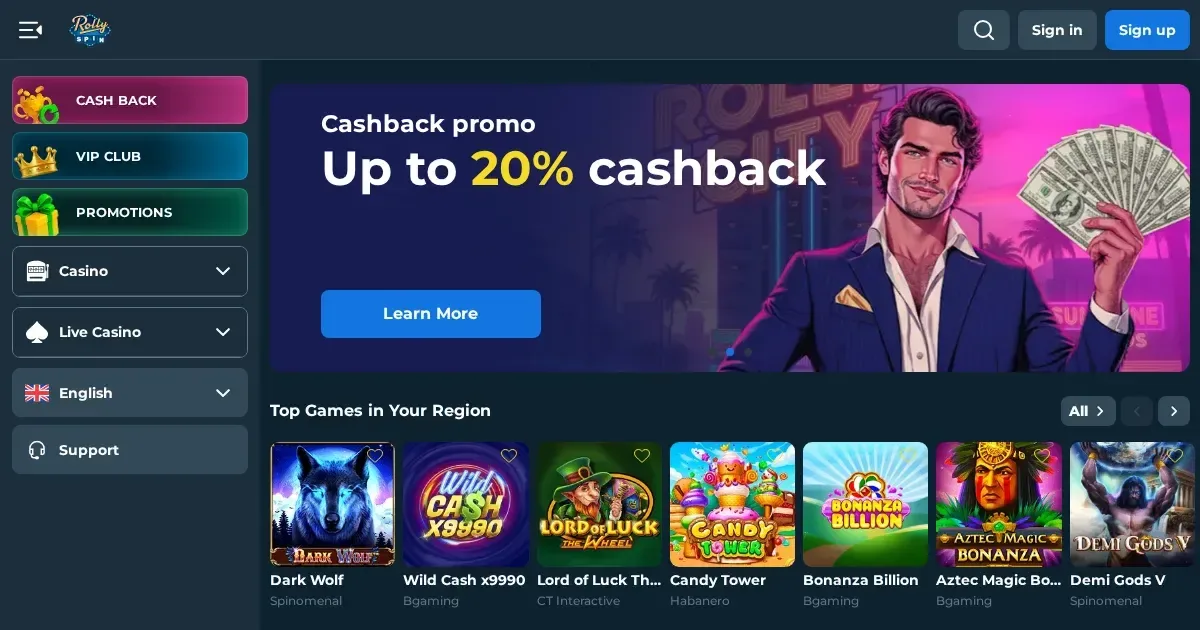
We built Rolly Spin for entertainment, and we want it to stay that way. This page exists for the moment gambling stops feeling like a choice – when the next spin matters more than it should, or when a loss changes your week instead of your evening.
Why responsible gambling matters
Gambling works as entertainment when you decide how much time and money it gets, and when stopping feels as easy as starting. It stops working when those decisions reverse – when the game decides your budget, or when walking away feels impossible.
We see it as our responsibility to give you the tools that make stopping straightforward, and to point you toward help that actually works when you need more than a timer can offer.
Signs gambling is getting out of hand
These behaviours show up before the money problems do. If two or more feel familiar, it's worth pausing:
- Chasing losses with bigger bets or more sessions than you planned
- Lying to family or friends about how much you've spent or how often you play
- Borrowing money, selling belongings, or using credit to fund play
- Gambling to escape worry, guilt, or low mood rather than for enjoyment
- Neglecting work, relationships, or responsibilities because of time spent playing
- Feeling restless or irritable when you try to cut down or stop
Questions worth asking yourself
Six questions, honestly answered, tell you more than any outside checklist. This is not a diagnosis – it's a mirror:
- Have you ever gambled longer than you intended?
- Do you return another day to win back losses?
- Have you borrowed money or sold anything to gamble?
- Has gambling caused problems with your family or work?
- Do you feel guilty or anxious after gambling?
- Have you tried to stop or cut down and found you couldn't?
One "yes" is a reason to set limits. Three or more is a reason to talk to someone – the organisations below cost nothing and judge nothing.
Our control tools
We offer self-exclusion for any period up to 12 months. Request it by email to our support team, and your account locks immediately – no deposits, no logins, no promotional messages. The block stays in place for the full term you specify, with no shortcuts.
You can also disable all promotional messages through your account settings or by contacting support. That stops emails, SMS, push notifications, and bonus offers. Your account stays open, but the nudges stop.
Both tools are irreversible once set. That's the design – a cooling-off period works only when it can't be shortened on impulse.
Practical limits that work
The tools above are reactive. These habits keep you ahead of a problem:
- Decide the amount before you deposit. Treat it as the cost of an evening out – gone once spent, never topped up mid-session.
- Set a timer for 45 minutes. Walk away when it sounds, regardless of balance. Fatigue makes bad decisions feel reasonable.
- Never chase. A loss is the price you paid for the session. Winning it back doubles the stake, not the odds.
- Keep gambling money separate. A dedicated card or e-wallet account makes overspending visible before it happens.
- Track every session. A simple spreadsheet – date, deposit, withdrawal – shows the real cost over a month.
Where to get help in the UK
GamCare runs the National Gambling Helpline at 0808 8020 133, free and open 24 hours a day. Trained advisers offer confidential support, whether you're worried about your own play or someone else's. Visit gamcare.org.uk for live chat and self-assessment tools.
BeGambleAware provides advice, forums, and a directory of local treatment services across England, Scotland, and Wales. Start at begambleaware.org.
GamStop is a free national self-exclusion scheme. Register once at gamstop.co.uk, and you're blocked from every UK-licensed gambling site for six months, one year, or five years. It covers casinos, sports betting, bingo, and poker – everything under a UK Gambling Commission licence.
Gordon Moody offers residential treatment and online therapy for gambling addiction. Referrals are free; find out more at gordonmoody.org.uk.
Blocking software
Gamban (gamban.com) blocks access to gambling sites and apps across all your devices – phones, tablets, laptops. It runs in the background and can't be bypassed without uninstalling, which takes 24 hours. A subscription costs around £20 per year, but many UK treatment providers offer free licences.
BetBlocker (betblocker.org) is completely free and works on Windows, macOS, Android, and iOS. It blocks tens of thousands of gambling domains and updates its list automatically. Once installed, it stays locked for a minimum period you choose.
Protecting minors
You must be 18 or over (18+) to hold an account or place a bet. If you share a device with someone younger, parental-control software such as Net Nanny or Qustodio blocks gambling sites at the router level and monitors app installations. Both work across all devices on your home network.
Keep your login credentials private, and log out after every session if others use the same device.
Our commitment
We review accounts for signs of problematic play – deposit patterns, session length, and chasing behaviour. Where we see concern, we'll reach out. That might feel intrusive, but a short conversation is preferable to silence when something is wrong.
For questions about any of the tools on this page, or to request self-exclusion, contact [email protected]. We respond within 48 hours, and exclusion requests are actioned immediately.
Gambling should be entertainment, not a chore. If it stops feeling that way, the organisations above exist to help you get that balance back.
This site is for players aged 18 and over (18+). If gambling ever stops feeling like a choice, free and confidential support is available at BeGambleAware.org.